

In this blog, I dive into how Crown of Horns explores sex and gender. Here’s what’s on the menu:
- The feminist works of artist Audra Balion.
- How I stumbled into a fun trans character.
- Sneak peek into my next book!
Flight Nineteen and Feminism
I’ve spoken at length about how Crown of Horns fits into the wider world of Flight Nineteen created by artist Audra Balion. To ensure that my additions matched with the vision of her world, it meant leaning into her aesthetics: multi-armed people, human-animal hybrids, and the common motif of antlers and horns.
But why so many horned people in Flight Nineteen?

Gilded, a painting by Audra Balion.
For years, Balion has added horns to women. In paintings, illustrations, and sculptures, she has given women beautiful (or sometimes menacing) antlers and horns upon their head. When asked why, she offers up a couple of reasons: in part it’s because they are more interesting than just drawing regular folk, but the more meaningful reason is that it’s an exploration of feminism.
Balion takes these traits that are primarily associated with male animals (although there are many species where females have horns, too) and gives them to women. In some cases, horns and antlers are symbols of masculinity and power (think of male deer fighting with their antlers for dominance; there’s an idea of the one with the greater set of antlers is the one who has the most power). By depicting women with horns, she creates symbols of empowerment. She also portrays these symbols in ways that express her femininity: including jewelry and beads throughout the horns. She makes the symbol her own.
And all of this serves as a basis for depicting characters in Crown of Horns.

A kudu head on display at the Beaty Biodiversity Museum.
To Diverge or Not
Balion’s art primarily features women. And while men aren’t the focus of her work, she has noted with me that she does not tend to think of her designs as being sexually dimorphic. Sexual dimorphism refers to the physical difference between the male and female of a species. So, in this case what I mean is that Balion does not intend any additional differences beyond the human baseline. So, when she draws a woman from the land of Faethryn with antlers, she assumes that a man will have the same antlers. While this is not the case with all animals in nature, that has been her approach.

Illustration by Audra Balion from Crown of Horns
When creating characters in her world, there were places where I aligned with that approach and places where I didn’t. Oksanans, whether male or female, have the same horns. But the Feras, the masked people from beyond the Greenshield, are quite a bit different. They have no horns, but men and women possess a different number of arms: four and two respectively. There are, of course, exceptions. Kalrevi’s father has six. And Dr Lakira is a woman with four.
Suddenly Trans in Feras Society

Kalrevi and Surrendra walk alongside the Greenshield.
When the idea first sparked for Dr Lakira, a four-armed Feras woman, I imagined her additional arms were similar to Kalrevi’s father. It just so happened that through a genetic hiccup, she ended up with extra arms. This, of course, is not explicitly stated and it leaves room for interpretation. My beta readers were the first to ask if Dr Lakira was trans and when it clicked, the answer had to be yes. Not only was this more interesting to me, but it actually has some interesting implications for Feras society.
Dr Lakira’s trans identity gives us a bit of worldbuilding that is too good to not make it canon.
No spoilers, but if you haven’t read Crown of Horns, let me lay out the Feras a bit. They are a xenophobic people who live in a concealed place behind the Greenshield, a massive expanse of grass as tall as redwoods. When they learn a skill that allows them to contribute to society, they put on a mask and wear it for all of their lives. The mask is plain, white, and featureless. Individuality does not matter in the world of the Feras, what matters is the society. All members work toward the good of the group.
Now, you’d think that such a society might condemn someone for being trans, or even homosexual. After all, that could challenge their ability to produce offspring and thus be a detriment to Feras as a whole. But note what I said above for when they take their mask. Donning the mask for the first time is, in essence, the Feras coming of age ceremony. But it is not done at a certain age (like when someone can start producing offspring). It’s done when they have taken on their vocation.
Personal identity still exists for the Feras, and everyone is on board. So long as one is still working for the greater good of society. When Kalrevi is chastised by her father, it’s because her path to individualism is one that would separate her from Feras society. That is the far greater taboo.
While Dr Lakira plays a small role in the story, reading her as trans opens up a world of interesting complexity, and it was created by allowing for some additional sexual dimorphism. I stumbled upon her gender identity, but the depth in this one simple reading was inspirational for how I could explore these themes further.
Let’s get back to horns and where I’m going in my next book.
A Ksenyan Woman’s Horns Are Her Pride

Baba Raisa, Ksenya’s matriarch, with a fulsome set of horns.
Crown of Horns spends a lot of time describing Ksenyan women’s horns. We shouldn’t be surprised given the title.
Ishkara describes them as a woman’s pride. They grow for all of her life and Baba Raisa (Ksenya’s matriarch) suggests they are a symbol of a rich life, lived well, travelling along many different paths. When Siranna meets the matriarch, she wonders at how the old woman could possibly support her own head, given the volume of horns that have grown into a kind of “nest of brambles.”
This all follows the same way that Balion presents horns as a symbol of power. As Ishkara’s power grows, so do her horns. The most powerful woman in Ksenya is the one with the most horns. (Of note, this isn’t actually how political power is decided, but with their matriarchy, it is often the eldest, and thus the ones with the longest-growing horns, who become the authority.)
Because these horns grow all their lives, they become a testament of one’s longevity, wisdom, and authority within Ksenyan society. While we only meet a few Ksenyan women, we know their horns are important to them.
But what about the Ksenyan men?
The text says very little about the physical attributes of Ksenyan men. Siranna meets Oskar and Emil, a Ksenyan couple living in the city of Sophia. Her descriptions of the men focus more on their demeanours and on their eyes, whose rectangular, goat-like pupils remind her of Ishkara’s foreboding gaze. She doesn’t tell us whether or not they have horns.
I, of course, have some answers. After all, I’m the author and get to make some decisions in that regard.
Exploring Gender In Crown of Horns‘ Sequel
Sexual dimorphism opened up several opportunities for the Feras. Not only did it make them interesting and unique within the world, but it also offered up an opportunity to read in on how their society views sex and gender.
I wanted to explore a bit more about sex and gender in my next book, in particular as I introduced a non-binary character and have grappled with my own considerations on just what gender means to me. Dimorphism allowed me an opportunity to explore that even further and so that’s the direction I decided to go.
So, Ksenyan men don’t have horns! You’ve heard it here first.
This opened up a lot of world-building space to explore. In thinking about Ksenyan art, I considered the shape and spiral of their horns as being a recurring motif. But what would men do if they didn’t have any horns of their own? Well, it meant that they could get a lot more creative with their facial hair! So, you can look forward to meeting a collection of Ksenyan men with big, curly moustaches and multi-pointed beards!
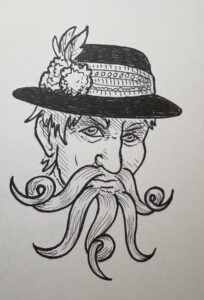
An illustration by of a Ksenyan man.
The next book will explore a lot about identity and horns become a symbol for that, whether one was born with those horns or not.
Hopefully, this gets you excited to see more of Vsevora and join me as I explore these ideas in my next book. Expect to pick up your copy of Horns of Shadow and Gold in September 2026! Until then, stay horny! …. Wait… oh no…..
